
For colleges, sixth forms and students' unions
A 30-minute CV session you can run with one printed sheet, and three short packs: applying to uni, getting through the year once there (money, renting, council tax), and the graduate job hunt. Everything below is free to download and print. If you'd rather hand out copies with your college's name and your own deadlines on them, email us about three weeks before you need them.
This is for careers leads and sixth form tutors with a tutor time slot to fill, and for advice teams in students' unions. The sheet and packs are written for students to read on their own, so you don't need a careers background or a working knowledge of student finance to hand them over. The CV session is the only part you'd stand at the front and run.
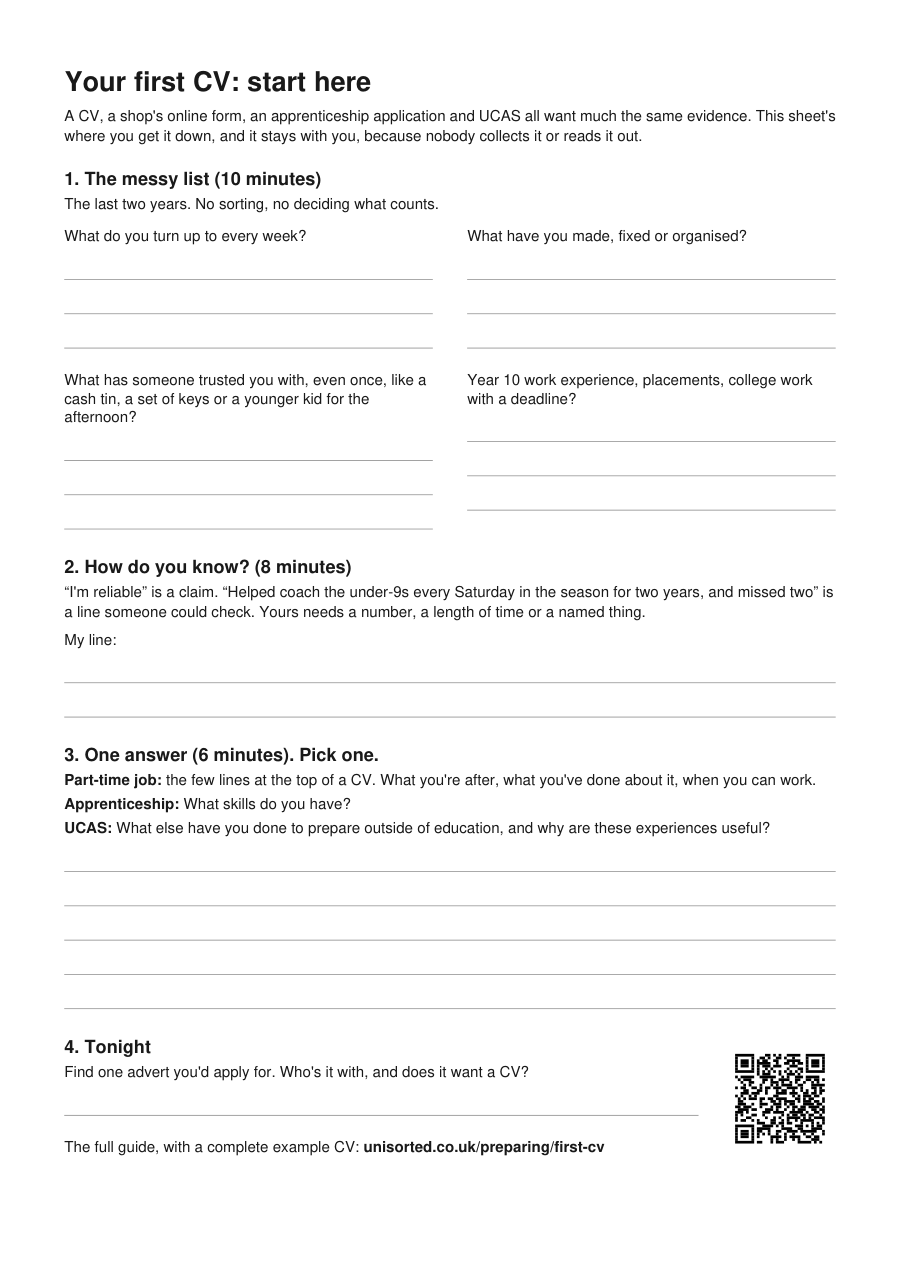
The first CV session
Thirty minutes in the room, one side of A4 per student, no slides. The session notes take about ten minutes to read the night before, and they include what to say at the start, a short exchange to read out with a volunteer, and what to do with the student who says they've never done anything. Your preparation is that read, the photocopying, pens and a board for one line, a minute practising the exchange, and two checks the notes list: whether your college filters new websites, and its rule on staff giving references.
Students leave with a page listing what they've done in the last two years, one line rewritten so someone could check it ("helped coach the under-9s every Saturday in the season for two years, and missed two" instead of "I'm reliable"), and a rough first go at the top lines of a CV, an apprenticeship form question or UCAS's third personal statement question. The sheet points them to a student guide with a complete example CV, so they can finish their own at home.
It's pitched at 16 to 19 year olds looking for a first job or an apprenticeship, and it works for Year 13s writing a personal statement too, since part 3 uses one of UCAS's three questions. Your Year 13s will hear about UCAS from every direction between now and January. I'd guess far fewer get asked what they've done that an employer could check, so if you only have one slot this term, that's the half hour I'd give it.
As far as I know, nobody has run it with a group yet. The notes say what I'd do if the pairs part runs over (it probably will, and then part 3 goes home with them), and if you do run it, I'd really like to hear what went wrong.
The three packs
These are A4 PDFs you can print or send to students' phones. There's nothing to run, and each one is dated, so you can see how old its figures are.
Applying to uni, 8 pages, for 2027 entry
By Sophie Chen, our university applications editor, for Year 13s applying through UCAS. It covers the January deadline and what happens if they miss it, the three personal statement questions, firm and insurance choices and reply dates, when student finance in England opens for 2027 starters, what the loan comes to, and a halls sum to do for each university before they firm. The last page has urgent help numbers for all four UK nations. Download the Applying pack.
At uni, 10 pages, for 2026/27
If you're in a students' union advice centre, this is the one to point people at in January. Jamie Hartwell, our student money editor, wrote it for students who've already started. Most of the pages are about money, starting with how to make the January loan payment last until April, and they cover part-time work, overdrafts and council tax too. The rest is finding next year's house under England's new renting rules, and who to talk to when things get hard. Download the At-Uni pack.
Graduate jobs, 5 pages
Priya Sharma, our graduate careers editor, wrote this one for final years and recent graduates, and it's the shortest of the three. It sets out a plan to start on a Monday, the CV's first lines, which employers to put on the list, and what the government's schemes for young people on Universal Credit actually do (one of them pays the employer, not the graduate). Download the Graduate pack.
Print as many copies as you need for your own students, and put the links on your VLE or in a tutor group email. If something needs changing, please ask us instead of editing the PDF. And if you link to our file instead of uploading a copy, your students get our corrections as soon as we make them.
Copies with your college's name and dates
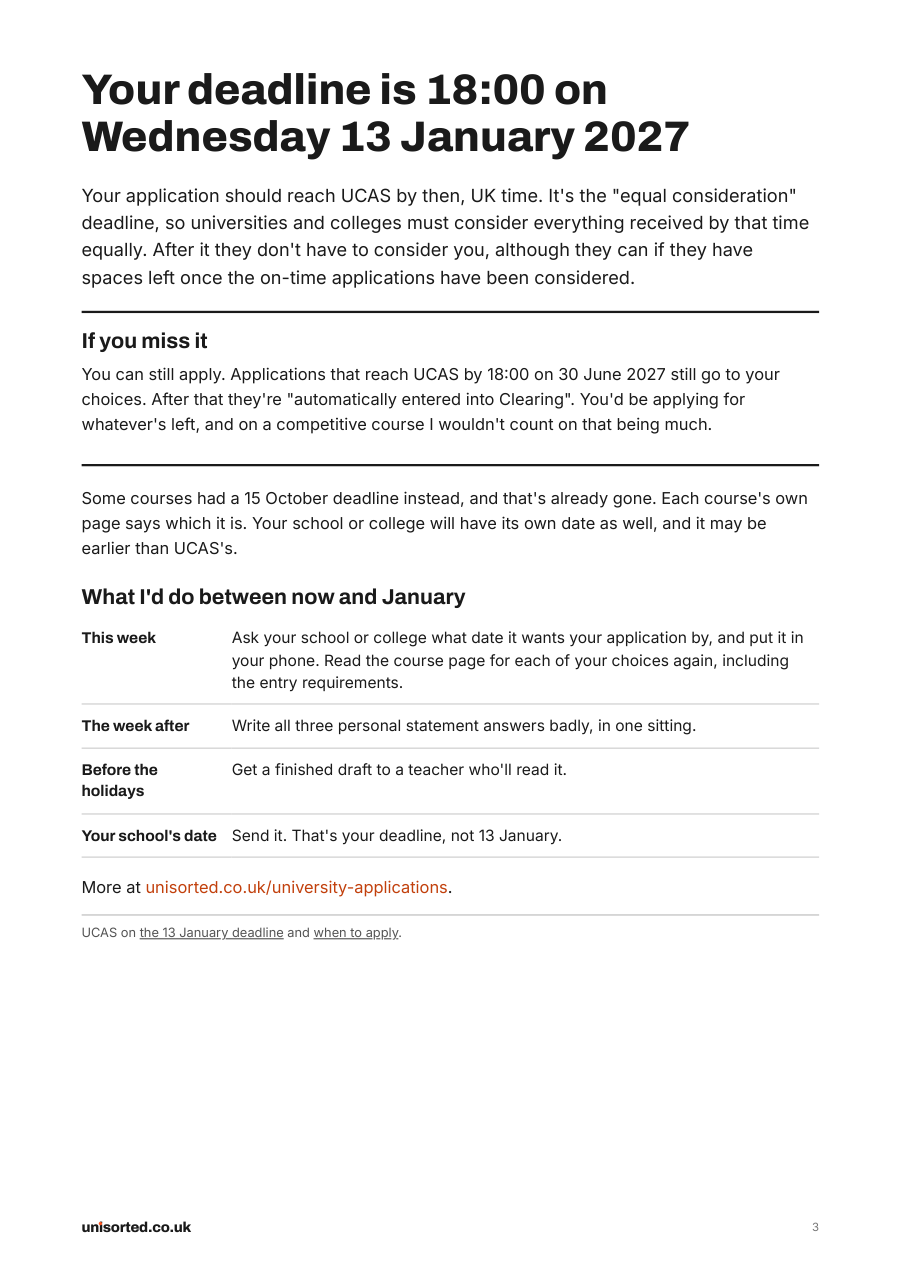
Page 3 of the Applying pack is a good example. It gives UCAS's deadline, then a four-line plan whose last row says "Your school's date". On your copy, that row would carry your actual internal deadline, and the other three rows would get real dates from your term calendar.
For the CV sheet, a named copy has your college's name at the top and a line in part 4 saying where students can find your careers adviser and when. A students' union's copy of the At-Uni pack can carry your advice centre's details on the help page, and your university's own hardship fund page on the January one.
The advice itself stays the same. We don't print anything we haven't read at its source, so if you want a figure of your own in there, such as a bursary amount, tell us where it's published and we'll read it there.
Asking for a named copy
Email hello@unisorted.co.uk (that link fills in the subject and five headings for you). Tell us the name as you'd like it printed, which of the CV sheet and the three packs you want, your dates, the contact details students should see, and when you need them by, and we'll tell you whether we can make that date. We make each named copy by hand, so allow ten working days from when we've agreed the details. Please leave out anything about individual students, as we don't need it.
We haven't set a price for named copies yet. We'll tell you what yours would cost, if anything, before we make it, and you won't owe anything you haven't agreed to.
Megan Ellis, University Prep Editor
Last updated: 11 November 2026