
Housemate Agreements
By Tom Okafor · Updated 7 October 2026

Why you need a written house sharing agreement
Create a written contract between you and the people you live with to set clear rules for your shared student house. You use this document to agree on cleaning schedules, bill contributions, guest policies, and noise levels.
Unlike your official tenancy agreement, this one is between you and your housemates only, and it does not change what any of you owe the landlord. It acts as a reference point to prevent arguments before they start. Draft and sign this paperwork during your first week in the property.

Many student houses are let on one joint tenancy. This means all tenants sign the same contract, and you are jointly and severally liable for the rent and for damage. If your housemate punches a hole in the wall or stops paying rent, the landlord can legally demand the money from you. Your guarantor can be at risk too. Unless the guarantee is limited to your share, the landlord can ask your parents, or whoever signed for you, to pay a housemate’s unpaid rent.
A written agreement forces everyone to acknowledge their financial responsibilities. It stops the classic argument over who owes what for the winter heating bill.
Consider a real financial scenario. You live in a four-person house with a total monthly rent of £2,400. Each person pays £600. If one housemate stops paying, the landlord can ask any of you for the missing £600. Split evenly, that is an extra £200 each for the remaining three tenants, and your housemate agreement should confirm that any individual who misses rent must repay the others immediately.
How to divide rent and utility bills fairly
Not all bedrooms in a student house are equal, and the person taking the master bedroom with an en-suite bathroom should pay more than the person taking the ground-floor box room. Agree on these pricing tiers before anyone signs the official tenancy agreement.
Calculate the total monthly rent for the property. Divide this by the number of tenants to find the baseline average. Adjust the individual prices up or down based on room size, natural light, and bathroom access.
If your total rent is £2,400 for four people, the baseline is £600. Charge £675 for the large en-suite room, £600 for the two medium rooms, and £525 for the small box room. Write these exact figures into your housemate agreement so nobody can claim they were overcharged later.
| Room Type | Monthly Rent Share | Reason for Price |
|---|---|---|
| Master En-suite | £675 | Private bathroom, largest floor space |
| Medium Double | £600 | Standard room, shares main bathroom |
| Medium Double | £600 | Standard room, shares main bathroom |
| Small Box Room | £525 | Smallest floor space, single bed |
Agree on a payment system before the first bill arrives in the post.
Never put all the utility bills in one person’s name. If your housemates refuse to pay, the supplier will chase the named account holder for the entire debt.
Put different names on different bills. One person takes the broadband contract, another takes the water bill, and two people go on the joint energy account. This spreads the legal risk across the household.
Alternatively, use a dedicated bill-splitting service. These companies combine your water, energy, and broadband into one package and charge each housemate their exact share via direct debit.
Bills Splitter Tool
Calculate exactly who owes what for your household utilities
Essential rules for cleaning and shared supplies
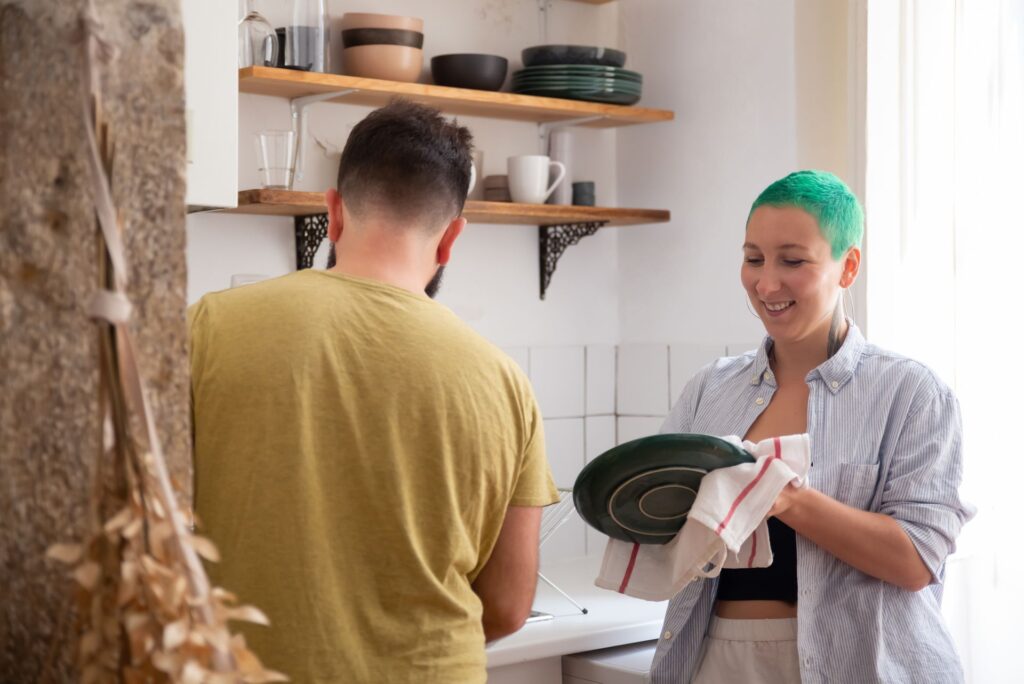
Your agreement needs specific rules to be effective. Vague statements like “keep the house tidy” will always cause arguments. Define exactly what tidy means in your household.
State that all kitchen surfaces must be wiped down immediately after cooking. Set a strict 24-hour limit for leaving dirty dishes by the sink. Create a rotating weekly cleaning rota for the bathroom, kitchen, and living room. Assign one specific task to each person every Sunday.
Morning bathroom clashes cause immense stress. Agree on a morning shower schedule if four people share one bathroom. Give priority to the person with the earliest lecture or shift. Limit morning showers to ten minutes to ensure the hot water tank does not empty before the last person gets their turn.
Household supplies create constant friction in shared student houses. Decide whether you will buy toilet roll, washing up liquid, and bin bags individually or through a shared pot.
Buying individually often leads to four separate bottles of washing up liquid cluttering the sink. It also causes resentment when someone uses your expensive olive oil without asking.
Set up a shared household pot. Specify in your agreement that everyone must transfer £5 into a designated bank account on the first day of each month. Use this money exclusively for communal items like bleach, sponges, and kitchen roll. Appoint one person to do the household shop and upload the receipt to a group chat.
Ban the sharing of personal groceries unless explicitly offered. Write a rule stating that food on specific shelves belongs solely to the person assigned to that shelf.
Setting clear guest and noise policies
The “invisible housemate” is a common cause of student disputes. This happens when a housemate’s partner stays over so often that they effectively live in the property without paying rent or bills.
Set hard boundaries regarding overnight guests. Agree on a maximum number of nights a guest can stay per week. Two nights is a reasonable place to start.
Include a rule stating that partners or guests can only stay over for a maximum of two nights per week without prior permission.
If a partner stays over four nights a week, they are using the shower, charging their devices, and taking up space in the fridge. Add a clause to your agreement stating that any guest staying more than three nights a week must contribute 10% to the monthly utility bills.
State that housemates must notify the group chat at least 24 hours before hosting a large pre-drinks or house party. Give everyone the right to veto a party if they have an exam or an important deadline the next morning.
Address the issue of heating and noise. Decide exactly which month the heating gets turned on and set a maximum thermostat temperature. Keep the thermostat at 19 degrees Celsius from November to March. State that nobody is allowed to use personal electric heaters in their bedrooms, as these are costly to run. At the capped rate for October to December 2026, a 1kW heater costs about 26p an hour.
Set strict quiet hours. Agree that music and televisions must be turned down after 11 PM on weekdays. This protects housemates who have early lectures or part-time jobs.
Resolving disputes and broken agreements
When someone breaks the agreement, address it immediately. Do not leave passive-aggressive notes on the kitchen counter. Speak to the person face-to-face while you are calm.
Refer directly back to the written agreement. Remind them that they read and signed the document. If the problem persists, call a house meeting. Discuss the issue as a group without shouting or making personal attacks. Focus on the broken rule, not the person.
Document any property damage immediately to protect your deposit. If a housemate spills red wine on the living room carpet, take a time-stamped photograph. Write down what happened and ask the responsible person to acknowledge it in your house group chat. This creates a digital paper trail. When the landlord deducts £150 from your joint deposit at the end of the year, you have proof of exactly who needs to cover that cost.
If internal communication fails, seek external help. Some universities run mediation for housemates. Ask student support or the advice service whether yours does.
Think twice before taking personal disputes to your landlord. Citizens Advice says a landlord is unlikely to want to get involved, and on a joint tenancy a landlord who does act on a serious problem can evict the whole household.
What happens if a housemate moves out early?
Sometimes a housemate drops out of university or refuses to resolve a major dispute. Leaving a joint tenancy affects everyone on it. In England, since 1 May 2026, any one joint tenant can give two months’ notice, and that notice ends the tenancy for the whole house. You cannot simply hand back your keys and stop paying your rent.
Finding a replacement is the usual way to leave without ending the tenancy for everyone. The remaining housemates and the landlord must officially agree to the new person. Check the prospective tenant carefully, as you will be jointly liable with them from here.
Until the tenancy is ended or changed, the person leaving is still a joint tenant and can be asked for the whole rent. If they stop paying before a replacement is found, the landlord can chase the rest of you for the shortfall.
Your housemate agreement should explicitly state that anyone leaving must cover their rent until a replacement is legally secured. It should also state that the departing tenant must pay any administration fees associated with the change.
In England, the Tenant Fees Act 2019 caps a change of sharer fee at £50 unless the landlord or letting agent can show that their reasonable costs were higher. If you are asked for more than £50, ask for proof of the cost. In Wales and Scotland they cannot charge for it at all.
Once a replacement is found, the landlord will draft a new tenancy agreement or a deed of assignment. Draw up a fresh housemate agreement with the new tenant as soon as they move in.
Calculate your personal budget limits using our student budget calculator before signing any joint contracts. Ensure your finances are organised by using our compare accounts guide to find the best student bank accounts for managing shared expenses.
Frequently asked questions
Are housemate agreements legally binding in the UK?
A housemate agreement is not part of your tenancy agreement and does not bind your landlord. But if a housemate refuses to pay their agreed share of a utility bill, you could use the signed agreement as evidence in a small claims court.
How to write a housemate agreement?
Sit down with your housemates during the first week of your tenancy to discuss the rules. Write down specific guidelines for cleaning rotas, guest limits, quiet hours, and bill contributions. Everyone must read the final document and sign it to confirm they agree to the terms.
What to do if a housemate stops paying rent?
If you are on a joint tenancy agreement, you are jointly and severally liable for the total rent. Talk to the housemate first, then tell your landlord early. You will probably have to cover the shortfall between you to stay out of arrears, but you can seek legal advice from Citizens Advice to pursue your housemate for the debt.
Can I kick a housemate out of a joint tenancy?
You cannot legally evict a housemate from a joint tenancy. Only the landlord can initiate eviction proceedings, and they must evict the entire household to remove one person. If a housemate is abusive or dangerous, contact the police and your university wellbeing team for immediate support.
Jamie writes to people already at uni
When your loan comes in, and what's due before it does. House deposits are the usual one.
You'll also get the At Uni pack as a PDF. Unsubscribe any time.

Ask Tom a question
If this guide didn't cover the thing you came for, ask. If enough people ask the same thing, it becomes a guide.
Read us often? You can add UniSorted as a preferred source on Google.