
How to Deal with Exam Anxiety: A Practical Guide
By Alex Sheridan · Updated 27 September 2026
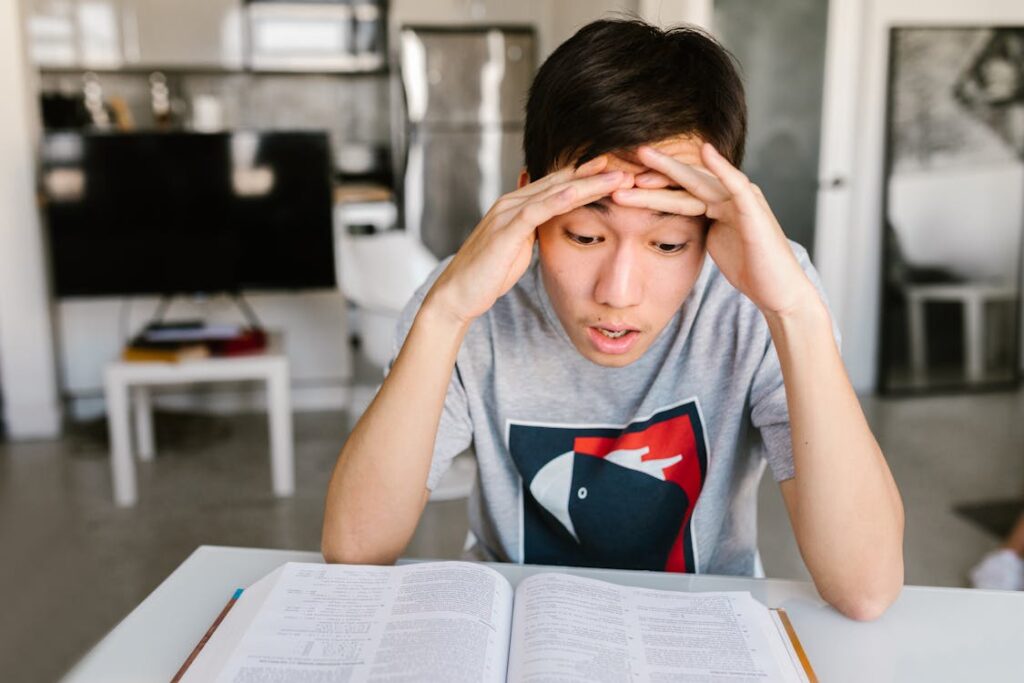
Exam season brings anxiety out in almost everyone. Your palms go sweaty, you open your notes and your brain goes blank, you wake up at 3am convinced you have forgotten everything. That is not weakness. It is your nervous system doing what it is designed to do under pressure. The good news: anxiety at manageable levels can actually sharpen performance. The bad news: when it tips into panic, it does the opposite. This guide gives you practical tools to keep it on the right side of that line.
After freshers' week
The At Uni pack is mostly about making the January loan payment last until April, and what to do if it doesn't.
Leave the box empty and you'll just get the PDF. Unsubscribe any time.
What exam anxiety actually feels like
Exam anxiety is not just nerves; it is a response your body triggers when it perceives a threat; in this case, the exam, and it can show up in several different ways:.
Our Exam Season Survival Guide 2026 covers timetabling, sleep, food, and managing panic across the full revision period.
Physical signs: heart racing, sweating, shaking, nausea, headaches, shallow breathing, needing the toilet more than usual.
Mental signs: racing thoughts, going blank, catastrophising, difficulty concentrating, forgetting things you knew perfectly well yesterday.
Behavioural signs: avoiding revision, spending hours with notes open without anything going in, procrastinating, snapping at people around you.
Recognising what is happening is the first step. Anxiety fools you into thinking the feeling is the reality. It is not. The feeling is information you can work with. Starting there tends to reduce how much power it has over you.
Breathing techniques that actually calm you down

Slow, controlled breathing is one of the few things that directly activates your parasympathetic nervous system, the part that tells your body it is safe to calm down. Here are two techniques that work quickly:
Box breathing: breathe in for four counts, hold for four counts, breathe out for four counts, hold for four counts. Repeat four times. You will feel a difference by the end of the second cycle. It is used by the military before high-stress situations for a reason.
Extended exhale breathing: breathe in through your nose for four counts, hold for seven counts, then breathe out completely through your mouth for eight counts. The longer exhale is key. It is more intense than box breathing and effective for the minute before you walk into an exam hall.
Neither technique takes more than two minutes; neither requires an app, a meditation cushion, or any prior experience; do them on the bus, in the bathroom, standing outside the exam room. They work wherever you are.
How to reframe the thoughts making it worse
Anxiety runs on worst-case thinking. The thought arrives ("I am going to fail this exam") and instead of questioning it, you treat it as fact and build a whole story on top of it. That story gets scarier with each iteration, and you have not even started revising.
The technique to break that cycle is simple but takes practice: catch the thought, challenge it, replace it.
Catch it: notice when you are catastrophising. "I am going to fail" or "everyone else is better prepared than me" are classic anxiety scripts.
Challenge it: ask yourself whether there is actual evidence for this. Have you failed before when you were this worried? Is "everyone else being better prepared" something you know, or something your anxious brain invented?
Replace it: swap the thought for something realistic and kinder; not toxic positivity ("I am definitely going to ace this!") but something honest; "I have not done everything I wanted to do. I know this material better than I did two weeks ago. I can do this."
This is cognitive reframing, and it is the basis of cognitive behavioural therapy (CBT). You do not need a therapist to learn the basics. It is a skill, and like any skill, it gets easier with repetition. Your university student support service can refer you to free CBT if you want more structured help. See also our guide to mental health at university and managing stress at university.
Revision strategies that reduce anxiety
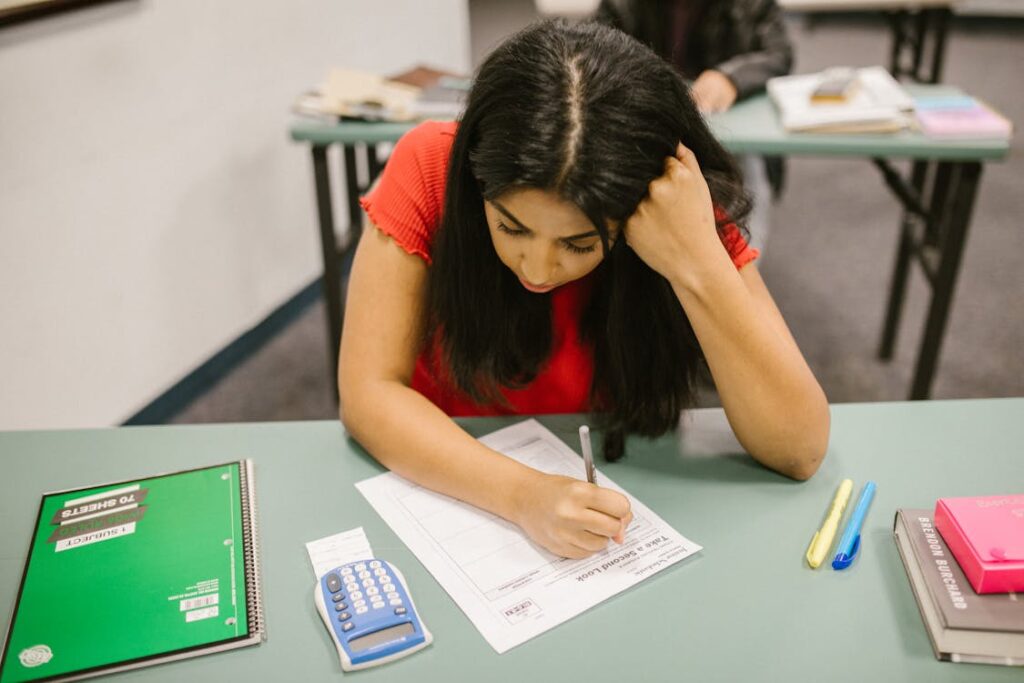
A lot of exam anxiety comes from uncertainty: not knowing whether you actually know the material. The fix is not more hours with your notes open. It is testing yourself so you know what you know and what you do not.
Active recall over passive re-reading. Close your notes, look away, and try to write down everything you remember; this feels harder and more uncomfortable than showing, which is why it works; your brain encodes information more deeply when it has to struggle to retrieve it.
Practice papers under timed conditions. Sitting in silence, working through a past paper with a clock running is the closest preparation to the real exam. It removes some of the unknown, and it shows you exactly where your gaps are. Stop revising topics you already know. Spend time on the ones you do not.
Spaced repetition. Revisiting material at intervals rather than in one long cramming block improves retention significantly. Free tools like Anki let you set this up automatically. Even spacing your revision across weeks rather than the night before makes a real difference to how much sticks.
| Revision method | Effort level | Actual effectiveness |
|---|---|---|
| Re-reading notes | Low | Low: feels productive, rarely is |
| showing | Low | Low to none |
| Making summary notes | Medium | Medium (useful for initial review) |
| Flashcards and active recall | High | High |
| Past papers under timed conditions | High | Very high |
| Spaced repetition | Medium | Very high over time |
If most of your revision sits in the low-effort column, that is probably contributing to the anxiety. Passive revision methods feel like revision without building the confidence that comes from actually knowing the material.
Sleep, food and moving your body
The basics still matter, especially during exam season. Anxiety gets significantly worse when you are sleep-deprived, under-fuelled, or sedentary.
Sleep. All-nighters are a well-documented own goal. Your brain consolidates memories and processes information while you sleep. Cutting sleep cuts your ability to retrieve what you have studied the next day. Even if it feels like you should study more, sleeping is revision.
Food. Skipping meals to save time is not saving time. It is burning through your concentration faster. Simple, sustaining meals beat elaborate cooking you will not actually do. See our guides on cheap meal planning for students and the cheapest UK supermarkets for students for practical, low-cost options.
Movement. A twenty-minute walk breaks the anxiety spiral and resets your ability to focus. You do not need a gym. You just need to not sit in the same chair for eight hours straight. Movement reduces the body stress response, which is what you need when revision is making everything feel worse.
When to reach out for help

The techniques above work for the level of exam anxiety most students experience. But if anxiety is stopping you from sleeping, eating, leaving your room, or functioning day-to-day, that is beyond exam stress. It is okay to ask for help with that.
Your university student support service. Every UK university has a counselling service or mental health adviser. Most offer same-week appointments during exam season. Look them up now, not when you are in crisis. Your student services page or student union will have the details.
Your GP. If anxiety is affecting your daily life, a GP appointment is the right step. You can ask for a referral to NHS Talking Therapies. Offers free cognitive behavioural therapy and other treatments without a lengthy wait in most areas.
Exam concessions. If anxiety is a diagnosed condition, speak to your university disability support team before exams, not after. Reasonable adjustments such as extra time, a separate room, or more frequent breaks exist and are there to be used. Our guide on DSA and disability support at university covers how to apply.
In a moment of crisis. Samaritans are available free on 116 123, any time of day or night. You do not have to be suicidal to call. They are there for anyone struggling and needing to talk.
One more thing worth knowing: if anxiety has prevented you from sitting or performing in an exam, most universities have a formal extenuating circumstances process. Talk to your personal tutor or student union before results come out, not after.
Managing anxiety on the day of the exam
Everything above is preparation. What do you do when the day actually arrives?
Arrive early enough, but not too early. Getting there with ten minutes to spare is fine. Getting there forty minutes early and standing in a crowd of anxious people is rarely helpful. You absorb other people's nerves without meaning to.
Do not compare preparation with others. That conversation outside the exam hall where everyone lists what they did and did not revise is almost universally counterproductive. Avoid it if you can, or steer it somewhere else.
Read the paper before you write anything. Spend the first few minutes reading every question properly. Mark the ones you feel most confident about. Start with those. Early momentum builds confidence for the harder questions.
If you freeze, breathe first. Box breathing for sixty seconds, then read the question again. The answer is usually there. Anxiety hides it temporarily, not permanently. If a question is unfamiliar, move on and come back to it. Spending ten minutes staring at one question you cannot answer is expensive. Spending two minutes on it, moving on, and returning later is not.
Keep perspective on individual questions. Getting one question wrong does not fail an exam. Getting one section wrong often does not fail an exam. The catastrophic story your brain tells you mid-exam ("I have failed, that's it, my life is over") is not based on the actual marking scheme. Do not let it take over the remaining time you have.
After the exam, close the chapter. Do not spend the evening doing a post-mortem with classmates on what you wrote. You cannot change it, and the conversation will only increase anxiety about the result. If you have another exam coming up, focus there instead.
Frequently asked questions
Is it normal to go blank in an exam even when I know the material?
Yes. This is called retrieval failure and it is a common anxiety response. If it happens, put your pen down, take three slow breaths, and read the question again. Calming your body first usually brings the memory back. Writing anything, even partial notes, also breaks the paralysis.
How do I stop comparing myself to other students?
You mostly cannot stop it, because comparing is automatic. What you can do is recognise that the comparison gives you useless information: you have no idea how prepared the person next to you actually is, and their performance does not affect yours in most exam formats. Redirect the mental energy to the one thing you can control, which is your own preparation.
Should I revise the morning of the exam?
A light review of key terms, formulas, or dates can help you feel settled. Attempting to learn new material on the morning of the exam will almost certainly not work and is likely to increase anxiety. If you have not learned something by the night before, the morning is not the time to learn it.
Does exercising really help with anxiety?
Yes. Movement releases endorphins, lowers cortisol levels, and improves sleep quality; the relationship between physical activity and reduced anxiety is well-established; it does not need to be intense. Walking counts.
My anxiety is about disappointing my family, not the exam itself. What do I do?
This is worth separating from normal exam nerves. Fear of disappointing others can be rooted in perfectionism or genuine external pressure such as family expectations or scholarship conditions. If it feels overwhelming, speaking to a counsellor at your university, even just once, can help you get perspective. It is sensible, not weak, to do that.
Jamie writes to people already at uni
When your loan comes in, and what's due before it does. House deposits are the usual one.
You'll also get the At Uni pack as a PDF. Unsubscribe any time.

Ask Alex a question
If this guide didn't cover the thing you came for, ask. If enough people ask the same thing, it becomes a guide.
Read us often? You can add UniSorted as a preferred source on Google.